
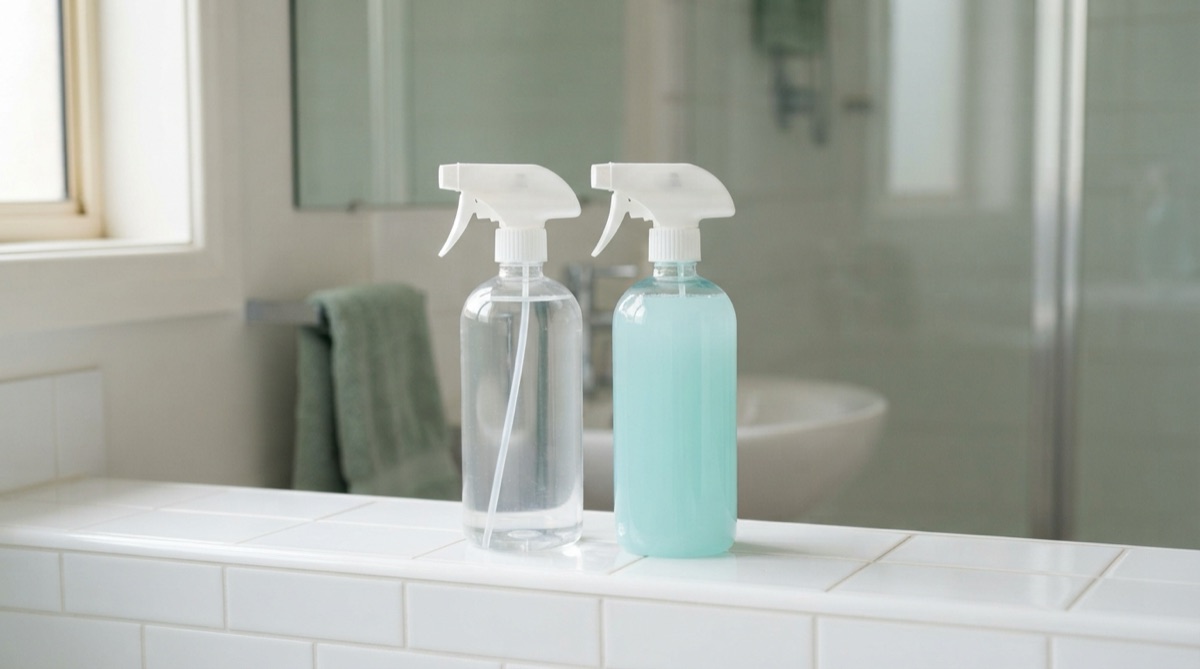
The verdict: removal beats killing
The best bleach alternatives for small mold spots start with physical removal. Scrub the growth off, rinse or wipe clean, and dry the area fully. Bleach can disinfect some hard surfaces, but killing mold is not enough if dead particles, damp caulk, or a leak stay behind.
Key takeaways
- Pick vinegar for small bathroom spots when you need lower fumes and the surface can handle acid.
- Bleach has a narrow lane: hard, nonporous surfaces, correct dilution, fresh air, and no mixing.
- The real fix is moisture control. Mold comes back when leaks, steam, or wet grout stay active.
- Stop DIY cleanup around the 10-square-foot mark; that is the homeowner cutoff.
Side-by-side choice guide
Use this table before you reach for a bottle. The right cleaner depends more on the surface than on the stain color.
| Situation | Better first move | Why |
|---|---|---|
| Light shower mildew on tile | Vinegar or detergent wash | Lower fumes and enough cleaning power for small surface spots |
| Mold on glass, porcelain, or hard plastic | Detergent first, then bleach only if disinfection is needed | Bleach works best after soil is removed |
| Mold on caulk | Replace failed caulk if stains sit under the bead | Cleaner cannot reach growth sealed inside |
| Mold on drywall, carpet, or ceiling tile | Stop and assess the water source | Porous materials may not clean completely |
| Mold after a leak or flood | Dry fast and call help if damage is broad | Hidden wet material can keep feeding growth |
| Natural stone shower | Stone-safe cleaner | Vinegar and bleach can damage finishes |
For a plain vinegar method, use our guide to cleaning mold with vinegar. If you are not sure whether the spot is mold or mildew, compare the signs in mold vs. mildew before choosing a cleaner.
Where vinegar fits
Vinegar fits small, visible mold or mildew on hard bathroom surfaces when you can scrub the growth away and dry the area after. For many small surface spots, soap, water, and white vinegar can work when paired with a brush and drying step — the same detergent-first approach EPA recommends for routine cleanup.
Use plain white vinegar on tile, glass, some plastic, and other acid-safe surfaces. Let it sit 30 to 60 minutes to loosen the film, the same dwell our mold-with-vinegar guide uses, scrub, then wipe clean with water. Do not mix it with bleach, peroxide, ammonia, or store-bought mold sprays.
Vinegar is not a registered disinfectant. That matters if the surface needs germ-kill claims, such as after illness or sewage contact. Registered disinfectants list the organisms they are approved to target, and the label controls where and how long the product must stay wet.
When bleach makes sense
Bleach makes sense only after the surface is already clean and the job calls for disinfection. Mold cleanup may use bleach or dish detergent, with no more than 1 cup of bleach in 1 gallon of water (CDC, 2024).
Bleach does not remove dirt by itself. Scrub first with detergent and water, then disinfect only if the surface, label, and room airflow make that a smart choice. Keep windows or doors open, wear gloves, and never use full-strength bleach on grout, paint, wood, fabric, or stone.
Does bleach kill mold on a hard surface? It can help on nonporous materials when diluted and used with enough contact time. The problem is that dead mold can still bother sensitive people, so the visible growth still has to be removed.
What bleach gets wrong
Bleach can make a dark stain look lighter before the mold problem is actually gone. That is why it can feel like it worked even when the damp joint, porous backing, or hidden leak is still active.
Routine use of a mold-killing chemical such as chlorine bleach is not recommended during normal mold cleanup (EPA). The same guidance says dead mold may still cause allergic reactions, so removal matters more than the word “kill.”
Bleach also brings more safety rules. Regular unscented household bleach is usually 5% to 9% sodium hypochlorite, and a mixed bleach solution loses strength after 24 hours (CDC bleach guidance, 2024). If the bottle does not list the percentage or gives different directions, follow the label or choose another product.
Mixing cleaners is the fastest way to make it worse
Never combine mold cleaners. Washington State Department of Health warns that chlorine bleach mixed with acids gives off chlorine gas, and vinegar is one of the acid products named in that warning.
This is the simple order: one product, one rinse or wipe step, then dry. If the first cleaner does not work, stop, ventilate, rinse the surface, and wait before trying anything else. A closed bathroom with shower steam is exactly where fumes build up fast.
Bleach alternatives for routine bathroom mold
Good alternatives to bleach are not exotic. For routine shower edges, start with detergent, water, a non-scratch brush, and dry towels. Add vinegar only when the surface is acid-safe and the spot is small enough to clean without disturbing hidden material.
Hydrogen peroxide can be useful on some hard surfaces, but it can discolor fabrics and some finishes. Store-bought mold removers may be right when the label names the surface and gives a realistic wet time. If a product needs 10 minutes of contact time, the surface has to stay wet for that full window.
For Rocklin, Roseville, and Sacramento homes, hard water can make shower glass and grout look worse than the mold itself. Remove mineral scale separately with a surface-safe product, then dry the area so new growth has less to feed on.
What to avoid on porous materials
Porous materials are the danger zone. EPA’s brief mold guide says ceiling tiles and carpet may need to be thrown away once they become moldy because growth can fill spaces and crevices that are hard or impossible to clean completely.
Drywall is similar when the paper face or backing is wet. Spraying bleach on the face can lighten a spot, but it will not dry the cavity or remove growth behind the surface. If a musty smell remains after cleaning, assume moisture is still somewhere.
Caulk also has a limit. Surface mildew can clean up, but black staining under old caulk often means the bead has failed. Pulling and replacing bad caulk is usually cleaner than soaking the same line again and again.
Mold keeps coming back when moisture stays
Cleaner choice matters less than water control. The same EPA guide gives a 24- to 48-hour drying window after a leak or spill to help prevent mold growth.
Bathrooms need the same thinking every week. Run the fan during showers and after, squeegee glass, keep shampoo bottles from trapping puddles, and leave the curtain or door open so edges dry. Indoor humidity should stay below 60%, with 30% to 50% as the better range.
Long dry spells in this valley keep bathrooms dusty and showers streaked with mineral film that settle debris into shower tracks. That film gives mold more to cling to when steam returns. A quick rinse and towel pass beats a bigger chemical job later.
When to stop and call for help
Stop DIY cleanup when the moldy area is larger than about 10 square feet, when there was sewage or heavy water damage, or when the HVAC system may be involved. Stop sooner if anyone cleaning has asthma, chronic lung disease, immune suppression, or strong mold allergies.
Call for help when the stain returns within days. Recurring mold usually means bad ventilation, failed caulk, a leak, wet backing, or a cleaning pattern that leaves the area damp. More bleach will not fix those causes.
If the problem is limited to bathroom surfaces and you want the room reset safely, our bathroom sanitizing service can target high-touch fixtures, shower buildup, and hard-water detail without guessing at harsh mixtures.
A practical pick for small bathroom spots
For most small bathroom mold spots, choose detergent and water first, vinegar second when the surface allows, and bleach only for hard-surface disinfection with clear label directions. That order keeps the focus on removal, drying, and safety.
If the spot is bigger than a small patch, smells musty, or keeps coming back, no bottle wins that fight — moisture does. A free estimate is the cheaper way to find out which one you are in.