
Three moves: lift, treat, dry
Most fresh stains need less cleaner than people think. Carpet stain removal starts with a dry white towel, cool water, and one tested cleaner matched to the stain. Blot from the outside in, rinse residue, and dry the backing so the spot does not wick back up.
Key takeaways
- Blotting is the first aid plan. Rubbing spreads color and can rough up the carpet face.
- Less liquid wins. Damp fibers are easier to rinse and dry than soaked backing.
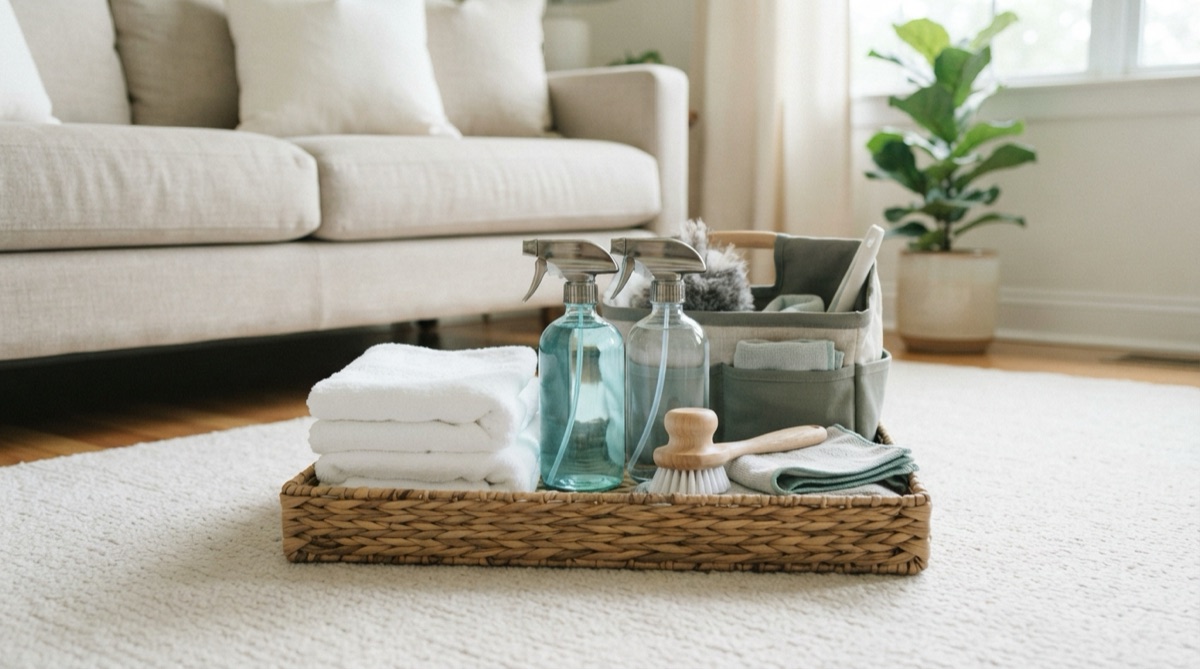
- Keep the kit small: white towels, a spoon, cool water, mild dish soap, white vinegar, baking soda, and an enzyme pet cleaner.
- Rinse after cleaning. Leftover soap re-soils fast and dries into a gray ring.
- Plan periodic deep cleaning. Normal professional deep cleaning sits at a 12- to 18-month rhythm for many homes (The Carpet and Rug Institute).
The first 3 minutes decide the stain
Move fast, but keep the work boring. Put a stack of white towels on the spill and press down. Shift to a clean part of the towel each time it picks up color or liquid.
Do not pour cleaner straight onto the carpet. Add water or cleaner to a cloth, then touch the cloth to the stain. That keeps moisture from running into the pad.
Scrape thick spills with a spoon before you blot. Salsa, frosting, mud, and food bits need to be lifted from the top, not rubbed sideways through the pile. Work from the edge toward the center so the stain does not grow.
If the spill is still wet, do not vacuum it with a regular household vacuum. Use towels, a wet extractor made for liquid, or a small carpet spot machine if you already own one. A dry vacuum is for crumbs, dry dirt, and dried baking soda.
Cleaners to keep ready
A small stain kit beats a crowded cabinet. You do not need five sprays with mystery ingredients. You need clean towels, plain water, a mild cleaner, and the patience to repeat light passes.
A baseline detergent mix is 1/4 teaspoon of liquid dish detergent in 1 cup of lukewarm water, followed by careful rinsing so residue does not pull soil back to the spot (CRI Spot Solver). Use a clear, mild dish soap without bleach, lotion, or heavy dye. Our vomit-cleanup guide uses a slightly stronger soap mix for heavy organic messes; both are label-safe starting points.
White vinegar is a follow-up tool for some water-safe synthetic carpets. The same spot guide lists 1 cup white vinegar mixed with 2 cups water as a mild acid rinse for certain spills. Test it first, and do not use it as a catch-all.
Baking soda is best for grease dusting and light odor pickup. Sprinkle it dry, let it sit, then vacuum it fully. If you wet baking soda into a paste, remove every bit; gritty residue can sit at the base of the fiber.
Skip laundry detergent, automatic dishwasher detergent, bleach, and strong solvent sprays unless the carpet label and product label both allow them. Laundry detergent can leave brighteners behind, and stronger mixes can change color faster than they remove the stain.
The stain chart for common messes
Use the lightest cleaner that fits the mess. If the stain is unknown, begin with cool water and blotting, then move one step stronger only after a hidden-spot test.
| Stain type | First move | Cleaner to try | Stop and call when |
|---|---|---|---|
| Coffee or tea | Blot liquid, then dampen lightly | Mild dish-soap solution, then rinse | Cream, sugar, or old brown rings keep returning |
| Red wine or juice | Blot hard with dry towels | Cool water, then a tested vinegar rinse | Bright dye remains after several light passes |
| Grease or gravy | Lift solids, dust with baking soda | Dish-soap solution on a cloth | The mark turns gray or spreads wider |
| Mud | Let it dry first | Vacuum dry dirt, then use mild soap | Red clay or tracked-in soil stains the backing |
| Blood | Use cold water only | Cold water, then a mild carpet-safe cleaner | Warm water was already used or color remains |
| Gum or wax | Harden it with ice | Chip gently, vacuum, then spot treat | The backing pulls or the fiber starts fraying |
| Pet urine | Blot, extract, and rinse cool | Enzyme cleaner made for carpet | Odor reaches the pad or covers a large area |
| Vomit | Remove solids and blot | Enzyme cleaner after a cool-water blot | Odor remains after drying |
For one of the hardest carpet emergencies, use our step-by-step guide to cleaning vomit out of carpet. It covers the odor side in more detail.
Treat the hard cases by stain type
The chart covers first moves. These three stain families need their own playbook.
Pet messes need odor control
Urine can be a stain, an odor source, and a pad problem at the same time. It can move through the carpet face, into the backing, and sometimes into the pad. If you clean only the top, the room may smell fine wet and sour again once it dries.
Start by blotting or extracting as much liquid as you can. Rinse with cool water in small amounts, then blot again. Heat is a bad shortcut because it can set some urine stains and odors.
Use an enzyme cleaner made for carpet and pet accidents, and give it the full time printed on the label — rinsing early cancels the work. Keep pets away while the cleaner works, then dry the area fully.
Homes with pets often get a second problem: dry grit sticks to damp traffic paths near doors, so a tacky spot widens with the next round of paw traffic.
If the accident happened on a rug over hardwood, protect the floor under it before you add moisture. Slide a plastic sheet or towel under the rug if you can lift it without spreading the mess. Then clean from the top with small amounts of liquid.
Do not judge odor while the carpet is still wet. Wet fibers can hide urine smell, and fragrance can trick you for a few hours. Check again once the area is dry and the room has had normal airflow.
For households that need routine cleaning without harsh product habits, our pet-friendly cleaning service page is the better fit after the stain itself is handled. Routine care cannot repair soaked padding, but it can keep surrounding rooms from turning one accident into a whole-house odor issue.
Old stains need a slower reset
An old stain is partly a cleaning problem and partly a moisture problem. The original liquid may be gone, but residue, dye, sugar, oil, or detergent can stay in the fibers. A heavy splash of cleaner often wakes the stain up and spreads it.
Vacuum the area first if it is dry. Then dampen a white cloth with cool water and press, lift, and check the towel. If color transfers, keep going with water before adding any cleaner.
If no color moves, test a mild soap mix in a hidden spot. Work in small rings from the outside toward the middle. Rinse with a mist of clear water and blot dry after each pass.
Old stains are where people get impatient. They scrub harder, use hotter water, or layer vinegar, peroxide, and soap together. That can leave a pale spot, a stiff patch, or a stain ring that is larger than the original spill.
If the carpet needs a full refresh and you do not have a machine, see our guide to cleaning carpet without a machine. For one small stain, stay tighter and wetter only where needed.
Rings and wick-back need drying control
A stain ring can form even when the color is gone. The edge dries last, so soil and cleaner residue can settle into a visible outline. That is why a wet circle often becomes a dry halo.
Rinse the center and edge the same way. Mist clear water lightly over the treated area, blot with a fresh towel, then repeat. You are trying to remove leftover cleaner, not soak the carpet again.
Wick-back is different. It happens when liquid under the surface rises as the carpet dries. The top looks clean at first, then the old spill comes back from below. Coffee, soda, wine, and pet accidents can all do this when the pad got wet.
Weighted towels help. Fold several white towels over the damp spot, add a clean heavy object, and leave them long enough to pull moisture up. Check the underside of the towel. If it shows color, replace it and keep drying.
Airflow helps too, but aim it across the room rather than blasting one small patch. A fan can speed drying, while direct heat can set some stains or leave the surface dry over a damp pad.
If the same outline returns after two careful rinse-and-dry rounds, stop adding cleaner. The stain may be deeper than the face fiber. At that point, more product can make the ring wider.
Carpet types that need extra caution
Synthetic wall-to-wall carpet is usually the most forgiving. Nylon and polyester can often handle mild water-based spot cleaning when the label allows it. Even then, the backing and pad still dislike too much liquid.
Wool, silk, jute, sisal, antique rugs, and hand-knotted rugs need a softer plan. Do not assume a pantry cleaner is safe because it sounds mild. Vinegar can bother some natural fibers, and water can brown plant fibers.
Berber and loop carpet can snag if you scrub with a stiff brush. Use pressure and patience instead. If a loop pulls, trim nothing until you ask a carpet pro or the manufacturer what to do.
Dark carpet can hide residue until it dries. Light carpet shows every ring. In both cases, use a white towel for testing, because a colored towel can transfer dye and make the stain worse.
When the fabric next to the carpet is also marked, handle it as a separate surface. Carpet methods do not always match sofa fabric, so use the right care route for upholstery cleaning before you treat chairs, cushions, or fabric headboards.
Make the spot kit easy to grab
The kit matches the one in the no-machine guide above — white towels, a dull spoon, a spray bottle, mild dish soap, white vinegar, baking soda — plus two pillar upgrades: a carpet-safe enzyme cleaner and a marker to date any mixed bottle.
Do not premix every cleaner. Soap solution and vinegar solution are fast to make, and fresh mixes are easier to trust. Old bottles under a sink can lose labels, grow cloudy, or get mistaken for another spray.
Keep one printed care note with the kit if your carpet is new. Warranty papers often warn against certain products or machines. In a panic, that note can save you from using a cleaner that voids coverage.
For parties, holiday meals, or move-out days, set the kit where adults can find it. The first person to see a spill should not have to search three cabinets while red drink sits in the carpet.
Mistakes that set stains deeper
Hot water is the wrong first move for many stains. It can set protein stains like blood and some food messes. Start cool unless the carpet manufacturer or cleaner label gives a different direction.
Scrubbing is another common damage point. Bristles can untwist fibers and leave a fuzzy patch after the stain is gone. That texture change can be more visible than the spill.
More soap is not more cleaning. Soap left in carpet grabs dirt, so the spot looks dirty again even after the original stain is gone. Rinse with light misting and keep blotting until the towel feels clean.
Mixing cleaners is risky and usually wasteful. Bleach, ammonia, vinegar, peroxide, and solvent sprays all have different jobs and safety limits. Use one product, rinse, dry, and reassess.
Do not cover a damp stain with furniture, rugs, plastic mats, or a towel you forget about. Airflow matters. A hidden wet spot can sour, wick upward, or leave a compressed mark in the pile.
For oily ink, marker, adhesive, and some dye stains, rubbing alcohol may have a role on the right surface. Use the limits in our rubbing alcohol stain removal guide before trying it on carpet.
When a stain becomes a bigger cleaning job
A stain is no longer a simple spot when the pad is wet, the room smells sour, or the carpet stays damp for hours. At that point, the question shifts to moisture, odor, and what got under the carpet face.
Flood water, sewage, large pet accidents, and moldy carpet need a different level of caution. Porous materials such as carpet may be hard or impossible to clean completely once mold grows into them (U.S. Environmental Protection Agency).
Paint, permanent ink, rust, furniture stain, hair dye, and strong chemicals can also be outside normal home care. Some spills remove color from the carpet instead of adding color to it. Cleaning cannot put dye back.
Call sooner when the carpet is expensive, new, under warranty, or part of a rental move-out. A small fee for the right cleaning can cost less than a bad DIY attempt that leaves bleaching, fuzzing, or a larger ring. If the issue is tied to a party spill, food trail, or several rooms, a whole-room reset may be smarter than chasing each mark one by one.
What to tell a cleaner if you need help
Good stain details save time. Write down what spilled, when it happened, what you tried, and whether the spot was hot, oily, sticky, or smelly. If you used a product, keep the bottle out so the cleaner can see the label.
Mention the carpet type if you know it. Also say whether the stain reached a rug pad, carpet pad, stairs, baseboard, or nearby upholstery. Those details change the safest next step.
Photos help when the stain changes. Take one picture before cleaning, one after blotting, and one after the carpet dries. If a ring returns, the cleaner can see whether it widened, faded, or moved with the pile direction.
Be honest about bleach, peroxide, ammonia, alcohol, or rented machines. A pro can work around earlier treatment only if they know what touched the fiber. Hidden chemical history is how small stains become pale patches.
A final check before the room goes back to normal
After the stain looks gone, touch the carpet with the back of your fingers. It should feel dry, soft, and like the carpet around it. If it feels sticky, rinse again with a small amount of clear water and blot.
If you suspect moisture reached deeper, go back to the weighted-towel move from the wick-back section and give it more time.
Vacuum only after the area is dry. That lifts the pile and removes dried baking soda or loosened soil. If the vacuum pulls up color, stop and let the area dry longer.
Our regular visits use eco-friendly, non-toxic products by default, but carpet stain work still starts with the spill type and the carpet label. The right cleaner is the one that removes the mess without leaving a second problem behind.
A good stain rescue ends quietly: no odor, no sticky feel, no wider ring, and no damp pad. If the spot needs more than home blotting and careful rinsing, request a free estimate — note what spilled, when, and whether the carpet is still damp, because those three details set the plan.